Home / Art Gallery / The National Gallery, London
The National Gallery, London
From the original Art on Stamps archive
You can admire below not only some of the best works of art ever created, but also one of the best investments ever made by a British government. In 1824, when the reigning monarch was George IV, an enlightened patron of arts, and the Prime Minister the Earl of Liverpool, the government decided to purchase 38 paintings from the Angerstein collection and with them create a National Gallery. Over the years since then the National Gallery has continued to benefit from sustained state support, allowing major purchases to go on being made. It has also benefited, since its earliest days, from generous private support, chiefly in form of giftd and bequest of paintings. Today it has matured into being one of the finest and most famous public collections of European paintings in the world. The Collection is still, fortunately, not vast in number but is perhaps unparalleled choiceness and balance in its representation of all major schools of painting. (Michael Levey, Director, 1973-1986).
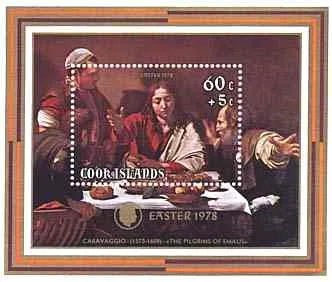
Michelangelo Merisi da Caravaggio , 1573-1610. The Supper at Emmaus . Christ, portrayed as an effete, beardless youth with a sensual face, has just blessed the bread and wine, thereby revealing to the two disciples that he is not a fellow pilgrim but the resurrected Saviour.
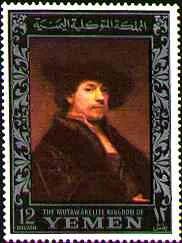
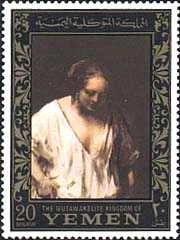
Rembrandt , 1606-1699. Self-Portrait , 1631. Rembrandt based his self-portrait at the age of thirty-four, on Titian's Portrait of a Man (see below). He shows himself as a slightly effete and even opulent young man. The face is highlighted by dramatic contrast between light and shade, the famous Rembrandt chiaroscuro. A Woman Bathing in the Stream. From about 1649 onwards Rembrandt lived with Hendrickje Stoffels. She seems to have been the model for this small oil sketch of a woman who has thrown aside a rich robe and is tentatively stepping into the water. More on Rembrandt.
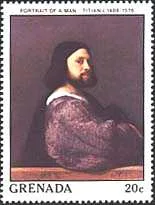
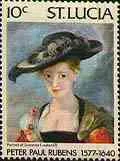
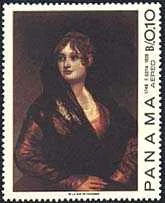
Titiano Vecellio , called Titian. Active before 1511, died 1576. Portrait of a Man. It has been suggested that this is a self-portrait, although during the 17th century it was thought to represent Ariosto, the author of Orlando Furioso. More about Titian. Sir Peter Paul Rubens , 1577-1640. Le Chapeau de Paille . Click here for more information about this wonderful masterpiece. Francisco de Goya , 1746-1828. Doña Isabel de Porcel. Goya said that he worked from Nature, Velasquez and Rembrandt. Doña Isabel, a friend of the Painter, is shown with her hands held proudly on her hips, her head held high. The full features of her face, which catches the light, are highly finished with rosy tints. We can be sure that Doña Isabel really was very beautiful, since Goya never flattered his sitters, and he never shrank from portraying ugliness.
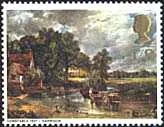
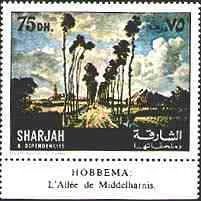
John Constable , 1776-1837. The Hay Wain. It is ironic that what perhaps the most popular English landscape painting was not appreciated by the English public when it was first exhibited at the Royal Academy in 1821. Constable has chosen a high viewpoint with a strong diagonal emphasis, to create a peaceful, rural idyll, in order to investigate in detail the phenomena of the natural world, and the changing effect of nature, particularly of light. Meyndert Hobbema , 1638-1709. The Avenue, Middelharnis, 1689 . Please click here for more information about the painter and the presented masterpiece.
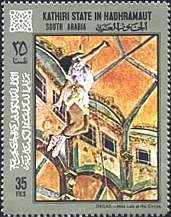
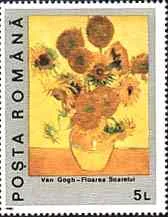
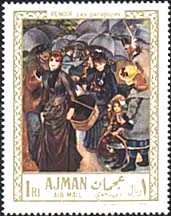
Edgar Degas , 1834-1917. Miss Lala in the Paris Circus Fernando , 1879. Please click here for more information about the painter and his work.. Vincent van Gogh , 1853-1890. Sunflowers . Please click here for more information. Pierre-Auguste Renoir , 1841-1919. Les Parapluies. There is in this paintings, as with many Renoir's paintings, narrative human interest. It has just started to rain, and we are left with dramatic uncertainty. Will the bare-headed girl accept shelter from the man immediately behind her. Or perhaps from the painter himself? (After Dillian Gordon). Link on this site to: Renoir