Home / Countries / Picasso and Members of His Family
Picasso and Members of His Family
From the original Art on Stamps archive
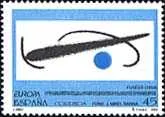
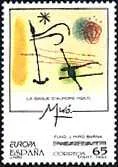
Miró drew on memory, fantasy, and the irrational to create works of art that are visual analogues of Surrealist poetry. These dreamlike visions, such as Harlequin's Carnival (1925, Albright-Knox Gallery, Buffalo) or Dutch Interior (1928, Museum of Modern Art, New York), often have a whimsical or humorous quality, containing images of playfully distorted animal forms, twisted organic shapes, and odd geometric constructions. The forms of his paintings are organized against flat neutral backgrounds and are painted in a limited range of bright colours, especially blue, red, yellow, green, and black. Amorphous amoebic shapes alternate with sharply drawn lines, spots, and curlicues, all positioned on the canvas with seeming nonchalance. Miró later produced highly generalized, ethereal works in which his organic forms and figures are reduced to abstract spots, lines, and bursts of colours.
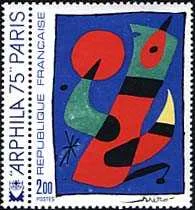
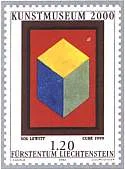
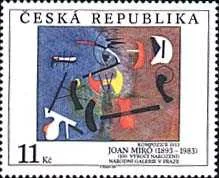
Joan Miró painted in a style often called biomorphic abstraction. This unique method features shapes that seem to float across the canvas; sharp bursts of color on a neutral background lead the eye across the picture plane. Miró is generally regarded as one of the leading figures in the Surrealist movement of the early and mid-1900s.
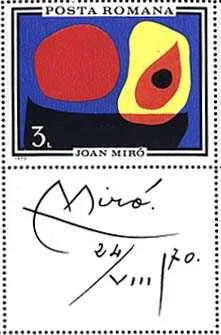
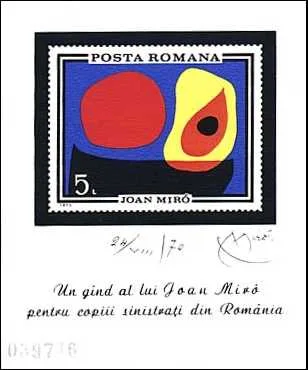
Miró also experimented in a wide array of other media, devoting himself to etchings and lithographs for several years in the 1950s and also working in water color, pastel, collage, and paint on copper and masonite. His ceramic sculptures are especially notable, in particular his two large ceramic murals, Wall of the Moon and Wall of the Sun (1957-1959) for the UNESCO building in Paris. Miró died in Majorca on December 25, 1983. (After Microsoft Encarta 1996).