Chinese Paintings on Silk, Shown on Stamps
Page by Sier, from China
B: Background: Mawangdui is located at Wulipai in the outskirt of Changsha, Hunan, about eight kilometers away from downtown of the city. Buried here were Dai Marquis Licang, his wife and son of the early West Han Dynasty (from 206 B.C. to A.D. 24). From early 1972 to early 1974, Chinese archaeologists carried out scientific excavation of Han Tombs No.1, 2 and 3, and unearthed several thousand treasured cultural relics.
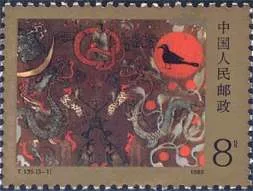
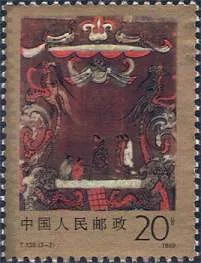
It was a rare archaeological find in terms of the variety of the relics and their good conditions, and provided a solid material proof for the research of social, political, economic and cultural development of the early Han Dynasty. The polychrome painting on silk discovered in Han Tomb No.1, with its substantial content, bright colours and unique way of expression, possesses great research and appreciation value in the art history of China.
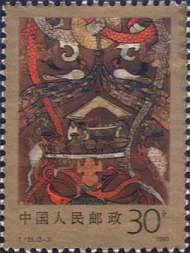
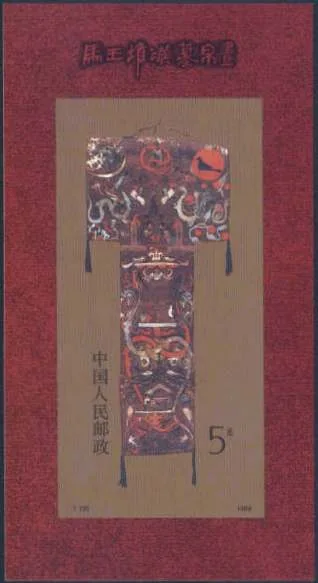
C: design (1)T135 The set consists of three stamps, entitled respectively as "Celestial Sphere", "Human Society" and "Underworld". These are three parts of the silk painting unearthed from the Han Tomb. The first stamp "Celestial Sphere" depicts a scene of the heaven where souls of the dead wish to stay. Painted at the center is an image of a snake with a human head. The second stamp "Human Society" portrays prominently an old woman walking slowly with a stick followed by three maids. Two persons are kneeling on the ground in the front to greet her, holding trays with food. She is painted taller than the rest to indicate her nobility. The third stamp "Underworld" portrays two crossing big fish or Kun (roc), an enormous legendary fish which could change into a roc. A naked man of great strength is squatting on the fish back holding in his hand a white flat object symbolic of the earth. Included in the silk painting, there are materials from Chinese mythology and also realistic portrayal of the times. Various bright colors such as cinnabar, azurite and mineral green are applied to the painting. The silk painting is a major reflector of the painting style of the early West Han Dynasty, and reveals the artistic achievement of the Han Dynasty. (2)T135m--[Miniature Sheet]. It is a miniature sheet showing the whole silk painting in the shape of a "T".