In the years after World War II (1939-1945), many Western leaders saw the policies of the Union of Soviet Socialist Republics (USSR) as threatening the stability and peace in Europe. The forcible installation of Communist governments throughout Eastern Europe, territorial demands by the USSR (the former Soviet Union), and their support of guerrilla war in Greece and regional separatism in Iran appeared to many as the first steps of World War III. Such events prompted the signing of the Dunkirk Treaty in 1947 between Britain and France, pledging common defence against aggression. Subsequent events, including the rejection by Eastern European nations of the European Recovery Program (Marshall Plan) and the creation of Cominform, a European Communist organization in 1947, led to the Brussels Treaty signed by most Western European countries in 1948. Among the goals of that pact was the collective
defense of its members.
The Berlin blockade by the USSR, that
began in March 1948, led to negotiations between Western Europe, Canada, and
the United States that resulted in the North Atlantic Treaty. (After
Microsoft Encarta 1996).
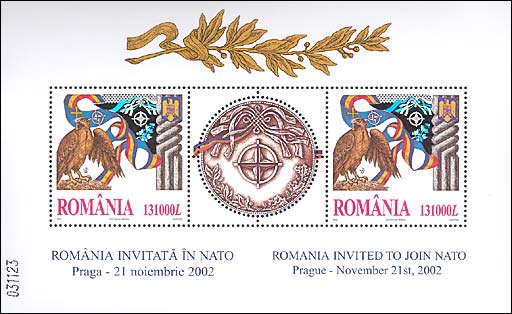
Featured above are:
-
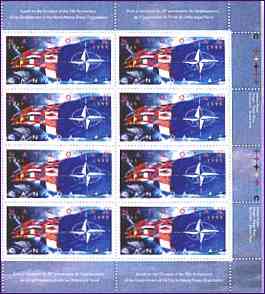
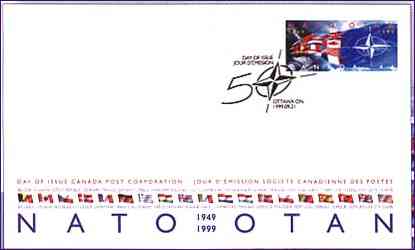
The FDC and the right half
of the sheet dedicated by the Canadian Post to the 50th anniversary of the
NATO
- The stamp issued by the
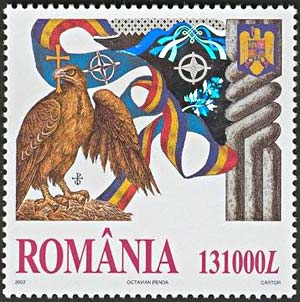
Romanian PA, 22nd of November 2002 (first Romanian hologram), "Romania invited to join NATO" .
-
The full Romanian sheet with two stamps
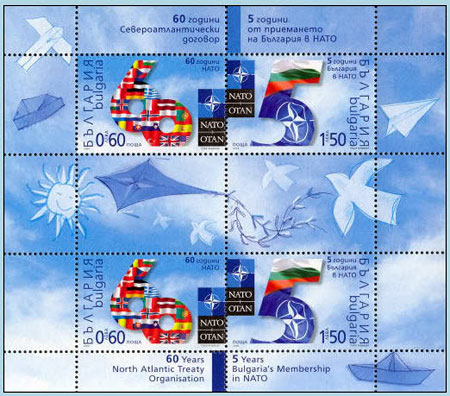
It is the place here to remember the fate of Romania's southern neighbor. Even if Bulgaria never declared war to USSR, and maintained diplomatic relations with this country, USSR declared war to Bulgaria on 5 september 1944 and invaded the country. The promised free election of 1946 were blatantly rigged, which marked the final establishment of a Communist regime in Bulgaria. It ended, like many others in this part of the world, only in 1989.
The above miniature sheet, issued 20 years after, in 2009, commemorates NATO's 60th Anniversary and 5th anniversary of Bulgaria's membership in NATO.